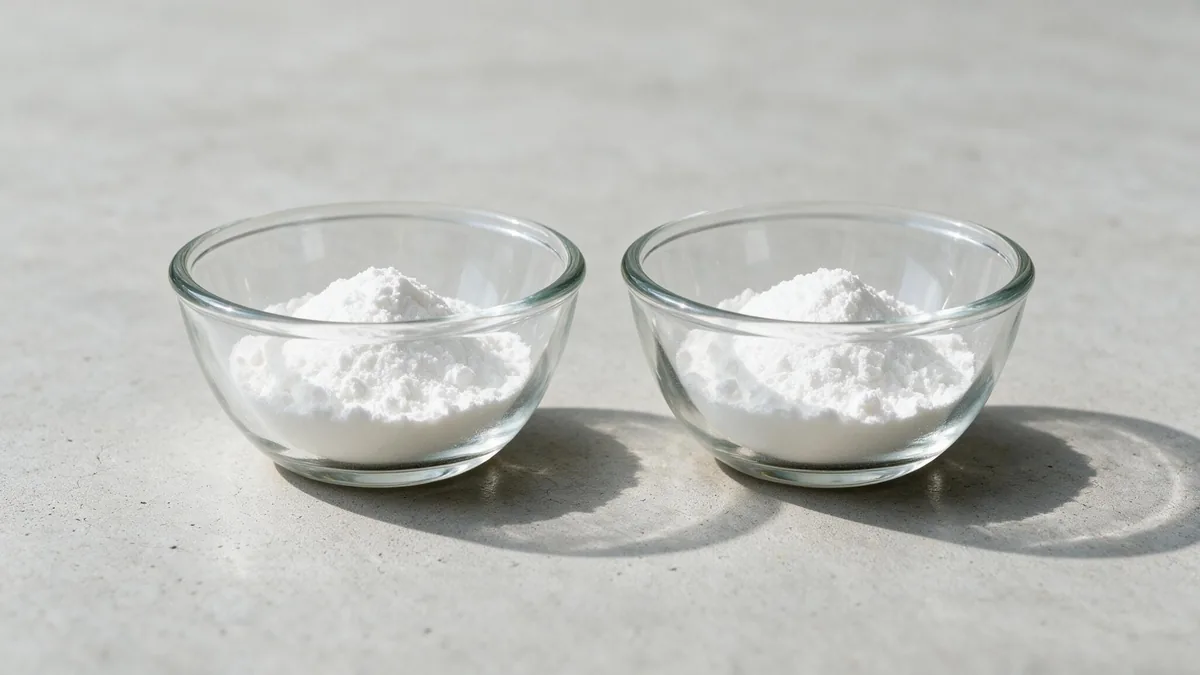
Buy creatine first. If you already eat enough protein across the day, branched-chain amino acids add very little on top — and the evidence behind them has weakened considerably as better studies have come out. Creatine's evidence has gone the other way: it has held up for three decades.
This is not a claim that BCAAs do nothing. It is a claim about priority, and about a specific condition — adequate daily protein — that most people reading this already meet or could meet more cheaply with food.
What BCAAs actually are
Branched-chain amino acids are three of the nine essential amino acids: leucine, isoleucine and valine. Leucine is the one that matters most, because it acts as a signal that triggers muscle protein synthesis.
That signalling role is real, and it is where the marketing came from. The problem is the step after it. Signalling the body to build muscle protein is only useful if the raw material — the other essential amino acids — is present. Muscle is built from all nine, not three. Sending a strong build signal without supplying the full set is like shouting an order into a kitchen that is missing most of its ingredients.
This is why the field has largely moved from BCAAs to EAAs (essential amino acids, all nine) — and why a whey protein shake, which already contains all nine including a substantial leucine dose, makes a standalone BCAA product largely redundant.
What creatine does differently
Creatine is not an amino acid supplement in the building-blocks sense. It tops up phosphocreatine in muscle, which is the energy currency for short, hard efforts — the last two reps, a sprint, a heavy single.
The effect is indirect but reliable: more available phosphocreatine means slightly more work per session, and more accumulated work across months produces more strength and lean mass. The International Society of Sports Nutrition describes creatine monohydrate as the most effective nutritional supplement available for increasing high-intensity exercise capacity and lean mass during training.
It also does not depend on your diet being deficient in anything to be useful, which is the key difference from BCAAs.
Side by side
| Creatine monohydrate | BCAA | |
|---|---|---|
| What it is | Energy substrate stored in muscle | 3 of 9 essential amino acids |
| Main claim | Strength, power, lean mass | Muscle building, reduced soreness, anti-catabolic |
| Evidence quality | Strong, consistent, decades deep | Weak once total protein intake is adequate |
| Redundant with whey? | No — whey contains negligible creatine | Largely yes — whey already contains all nine EAAs |
| Dose | 3-5 g daily, every day | 5-10 g around training |
| Works if diet is already good? | Yes | Much less so |
The one case where BCAAs might help
Being fair to them: the scenario with the most plausible case is training fasted, or training in a significant calorie deficit with protein intake that is genuinely low. In that situation, supplying amino acids around a session is not unreasonable.
Even then, EAAs make more sense than BCAAs, because they contain the complete set. And in most cases so does simply eating more protein — dal, eggs, curd, paneer, chicken or a whey shake are cheaper per gram of usable protein than a BCAA tub, and taste better than tangy amino acid water.
What about soreness and recovery?
BCAAs are often sold for reduced muscle soreness. Some studies do show modest reductions in soreness markers, but the practical significance is debated and the effect tends to shrink in better-controlled trials where total protein is matched between groups.
If recovery is your actual problem, the order of operations is unglamorous: sleep, total daily protein, sensible training load, and hydration — particularly in Indian summer, covered in how much water to drink with creatine. Supplements sit well below those.
Can you take both?
Yes, with no interaction. The question is budget priority. If you are choosing where a fixed monthly supplement spend goes, a sensible order for most people training for size or strength is:
- Enough protein, from food first, with whey as a convenience if you fall short.
- Creatine — cheap per serving, strongest evidence base in the category.
- Everything else, including BCAAs, pre-workout and fat burners, judged individually and sceptically.
If you are also weighing whey specifically, that comparison is in creatine vs whey protein, and combining them is covered in can you mix creatine with whey protein. The Coremax range is on the creatine monohydrate page, and it is made in India under licence rather than repacked from an import.
Frequently asked questions
Is creatine or BCAA better for muscle growth?
Creatine, on evidence quality. BCAAs signal muscle protein synthesis but supply only three of the nine amino acids muscle is built from, so they add little once daily protein is adequate.
Do I need BCAAs if I take whey protein?
Generally no. Whey already contains all nine essential amino acids including a substantial leucine dose, which is the main thing BCAAs are taken for.
Can I take creatine and BCAA together?
Yes, there is no interaction. They act through unrelated mechanisms and can go in the same shaker.
Are BCAAs useless?
Not useless, but far less useful than they were marketed as. The clearest case is training fasted or with genuinely low protein intake — and even there, EAAs or simply more protein are better answers.
Which is better value in India?
Creatine, comfortably. A 250 g tub at 3 to 5 grams a day lasts one to two months at a few rupees per serving, against a BCAA tub delivering a benefit that is conditional on your diet being poor.
Do BCAAs help with fat loss?
Not directly. Fat loss comes from a sustained calorie deficit. What matters during a deficit is holding protein high and training hard enough to keep muscle — creatine supports the second of those better than BCAAs do.
Sources
- International Society of Sports Nutrition position stand: safety and efficacy of creatine supplementation
- Examine.com — Creatine evidence summary
- Cleveland Clinic — Creatine
Creatine is a food supplement, not a medicine, and does not treat, cure or prevent any disease. If you are pregnant or breastfeeding, have kidney or liver disease or diabetes, or take prescription medication, speak to a doctor before starting any supplement.