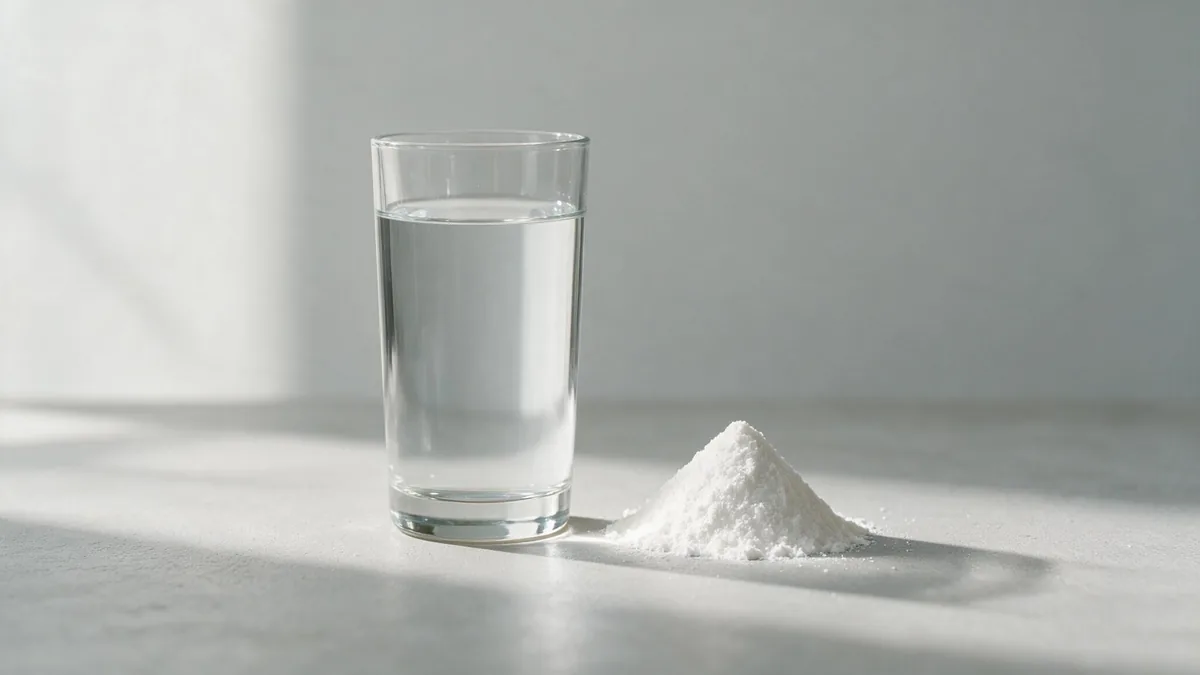
Drink about 500 ml of water with each creatine serving, and aim for 3 to 3.5 litres across the day if you train. That is roughly half a litre more than most people drink already. Creatine works by pulling water into your muscle cells, so the water is not a precaution against the supplement — it is part of how the supplement does its job.
That is the short answer. The rest of this page covers where the number comes from, why it climbs in an Indian summer, and why the old warning that creatine causes dehydration and cramps has not survived the research.
Why creatine needs water at all
Creatine is stored in muscle as phosphocreatine, and it is osmotically active — it draws water in alongside it. When your muscle stores fill up over the first few weeks, total body water rises, and almost all of that increase sits inside the muscle cell rather than under the skin.
This is why the scale often moves up 1 to 2 kg in the first fortnight and why the mirror does not show puffiness. It is also why hydration matters: you are asking your body to hold more water in a specific compartment, and it needs the water to do that. We cover the scale question in detail in does creatine cause bloating.
The actual numbers
There is no official creatine-specific hydration guideline, which is why the internet quotes wildly different figures. What the evidence supports is straightforward:
- Per serving: 300 to 500 ml of water, mainly so the powder disperses and reaches your stomach rather than sitting in the bottom of the shaker.
- Per day, if you train: roughly 3 to 3.5 litres in total, including what comes from tea, coffee, dal, curd and fruit. If you already drink around 2.5 litres, add about half a litre.
- During a loading phase: the upper end of that range. Loading means four servings a day, so you are drinking more anyway. A loading phase is optional — skipping it removes the question entirely.
Do not treat 3.5 litres as a target to force. Thirst plus pale-yellow urine is a better daily guide than a fixed number, and drinking far beyond thirst has its own risks.
Why the number is higher in India
Most creatine hydration advice online is written for temperate climates. If you train in Ahmedabad, Chennai or Delhi in May, your baseline sweat loss is already high before creatine enters the picture. A single hour of hard training in 40°C heat can cost well over a litre of sweat.
The practical adjustment is not a creatine adjustment — it is a heat adjustment. Drink to thirst through the day, add 500 to 750 ml around a hot training session, and pay attention to salt if you are sweating heavily for more than an hour. We go through summer training specifically in creatine in Indian summer.
Does creatine cause dehydration or cramps?
This is the most repeated claim about creatine and hydration, and it is the least supported. It dates to the late 1990s, when creatine was new and its water-shifting effect was assumed to mean water was being pulled away from somewhere it was needed.
The research since then has not borne that out. Studies in trained athletes exercising in heat have generally found no increase in cramping, no impairment of thermoregulation, and in some cases slightly better fluid retention. The International Society of Sports Nutrition's position stand states plainly that creatine does not cause dehydration or muscle cramping.
Two honest caveats. First, most of that research is in trained adults under supervision, not in someone doing two-a-days in peak summer with no hydration plan. Second, "no evidence of harm" is not the same as "protective" — creatine will not save you from poor hydration. Drink properly because you are training in heat, not because creatine forces you to.
What under-hydration actually looks like
These signs are about hydration generally, not creatine specifically, and they are worth knowing in an Indian summer regardless of what you supplement with:
- Dark yellow urine, or going more than five or six hours without needing to
- Headache and flatness through an afternoon session
- A heart rate that sits higher than usual at the same effort
- Sweat that stops in a hot session — this one is a warning sign of heat illness, not just thirst, and means stopping and getting medical help
Mixing: why some powder always stays behind
A related question comes up constantly. Creatine monohydrate does not fully dissolve in cold water, and that is chemistry rather than a quality problem — its solubility in water is roughly 13 to 14 grams per litre at room temperature. A 5 gram serving in 300 ml is close to that ceiling, so some grit at the bottom is normal and expected.
Warm water dissolves more than cold. Micronised powder — ground to a finer particle size, which is what the 200-mesh figure on our packs refers to — disperses faster and settles more slowly, but it still will not vanish completely. The practical move is to stir, drink, then swirl a little more water in the glass and finish that too, so the creatine at the bottom actually gets consumed. Micronised powder disperses more easily, which is why our packs specify a 200-mesh grind — the specification and our licences are set out on the FSSAI-approved creatine page, and the sizes are on the creatine range page. If someone tells you real creatine dissolves completely, read how to spot fake creatine — that myth is one of the least reliable tests going.
Frequently asked questions
How much water should I drink with creatine?
About 300 to 500 ml with each serving, and roughly 3 to 3.5 litres across the day if you train. Adjust upward in hot weather and use thirst and pale urine as your real guide rather than hitting an exact number.
Can I take creatine without drinking extra water?
You can, and nothing dramatic happens, but you are making it harder for your body to do what creatine is asking of it. Creatine raises the water held inside muscle cells, so a chronically low fluid intake works against the effect you are paying for.
Does creatine dehydrate you?
No. The concern dates to the 1990s and has not been supported by later research; the ISSN position stand states creatine does not cause dehydration or cramping. It also does not protect you from dehydration — hydrate for the heat and the training, not for the supplement.
Should I take creatine with cold or warm water?
Either works. Warm water dissolves more of it, cold water leaves more sediment. Neither changes how much creatine you absorb, as long as you actually drink what settles at the bottom.
Do I need more water during a loading phase?
Somewhat, because you are taking four servings instead of one and each carries its own glass of water. Loading is optional though — taking 3 to 5 grams daily reaches the same muscle saturation in three to four weeks without the extra fluid juggling.
Can I mix creatine into juice or a shake instead of water?
Yes. Creatine does not need plain water specifically — juice, milk or a protein shake all work, and the carbohydrate in juice may marginally help uptake. Just count that liquid toward your daily total rather than on top of it.
Sources
- International Society of Sports Nutrition position stand: safety and efficacy of creatine supplementation
- Cleveland Clinic — Creatine
- Examine.com — Creatine evidence summary
Creatine is a food supplement, not a medicine, and does not treat, cure or prevent any disease. If you are pregnant or breastfeeding, have kidney or liver disease or diabetes, or take prescription medication, speak to a doctor before starting any supplement.