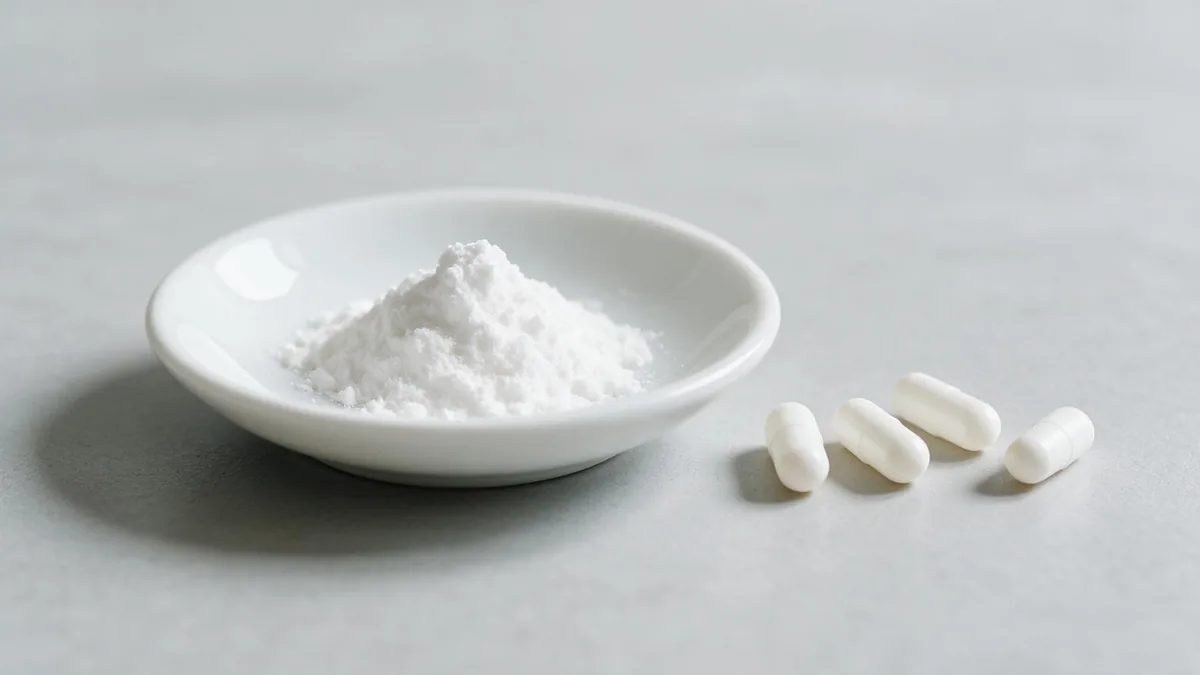
Powder, for almost everyone. Both forms deliver the same creatine monohydrate and both work, but capsules cost substantially more per gram and a proper 3 to 5 gram dose usually means swallowing four to eight of them a day. The only strong case for capsules is travel and convenience.
Absorption is not the deciding factor, despite being the thing most comparisons lead with. Once the capsule shell dissolves in your stomach, your body is handling the same molecule either way.
The cost problem
This is the real difference, and it is easy to miss because capsule tubs are priced per bottle rather than per gram of creatine.
Do the arithmetic before you buy. Take the total creatine in the container — capsules per bottle multiplied by grams of creatine per capsule — and divide the price by that number to get a cost per gram. Then do the same for a powder tub. Capsules typically come out several times more expensive for the same amount of creatine, because you are paying for encapsulation, a bigger container and more packaging.
A worked example of how to compare, using whatever the current prices are:
- A capsule bottle with 120 capsules at 750 mg creatine each contains 90 g of creatine. At a 3 g daily dose that is 30 days — and it takes four capsules a day.
- A 250 g powder tub contains 250 g of creatine. At 3 g a day that is over 80 days.
Compare the two on rupees per gram rather than rupees per bottle and the gap is usually obvious. Our own pricing across sizes sits on the creatine range page, and the broader market picture is in creatine price in India.
The dose problem
Capsules are commonly 500 mg to 1 g of creatine each. The maintenance dose supported by the research is 3 to 5 grams daily. That means:
- At 750 mg per capsule, a 3 g dose is four capsules; a 5 g dose is closer to seven.
- During an optional loading phase at around 20 g a day, you would be swallowing well over twenty capsules daily.
People underdose capsules for exactly this reason — taking two because two feels like a normal supplement dose, which delivers around 1.5 g and never fully saturates muscle. If you buy capsules, count the grams rather than the capsules.
The vegetarian point that gets missed
Creatine monohydrate powder is vegetarian: it is manufactured from sarcosine and cyanamide, with no animal input at any stage.
Capsule shells are a separate question. Many are gelatin, which is animal-derived. Vegetarian capsules made from HPMC (a plant cellulose) exist and are usually labelled as such, but plenty of products do not make the shell material obvious. If you are strictly vegetarian, powder removes the ambiguity entirely — and India has the largest vegetarian population in the world, so this matters more here than in most markets. There is more on the dietary angle in creatine for vegetarians.
Where capsules genuinely win
Two situations, and they are real:
- Travel. A strip of capsules in a bag is simpler than a tub, a scoop and a shaker, and avoids awkward conversations about a bag of white powder at security.
- You will not otherwise take it. The best supplement is the one you actually take daily. If the powder-and-shaker routine means you skip it half the week, capsules that you swallow with breakfast are worth the premium.
There is also a taste argument, though unflavoured creatine in juice or a shake is close to undetectable, and flavoured versions exist precisely for people taking it in plain water.
What about tablets and gummies?
Tablets are compressed powder and behave much like capsules — check grams per tablet and the cost per gram.
Gummies deserve more caution. Creatine is not especially stable in the presence of moisture and heat over time, and a gummy is a moist product that may sit in a warm Indian supply chain for months. Independent testing of creatine gummies in other markets has repeatedly found less creatine than the label claims. If you buy them, treat the stated dose sceptically and prefer brands that publish batch testing.
What actually matters more than the format
Whichever form you pick, the checks are the same:
- Creatine monohydrate as the form. It is the most researched and the ISSN's stated benchmark; newer forms charge more without matching the evidence, as covered in monohydrate vs HCl.
- A stated amount per serving rather than a proprietary blend.
- An FSSAI licence number printed on the pack, checkable on the government FoSCoS portal — see our FSSAI-approved creatine page.
- Batch and expiry printed, not stickered, and third-party testing you can actually see.
Frequently asked questions
Are creatine capsules as effective as powder?
Yes, provided you take the same number of grams. The form does not change the molecule; it changes how many units you swallow and what you pay per gram.
How many creatine capsules equal one scoop of powder?
Depends entirely on the capsule strength. At 750 mg per capsule, a 3 g scoop is four capsules. Read the grams of creatine per capsule on the panel — not the capsule count on the front.
Are creatine capsules vegetarian?
The creatine is. The shell may not be — gelatin shells are animal-derived. Look for HPMC or an explicit vegetarian mark, or use powder, where the question does not arise.
Which is cheaper, creatine powder or capsules?
Powder, usually by a wide margin. Compare on cost per gram of creatine rather than cost per bottle, and the difference becomes clear.
Do creatine capsules cause less bloating?
There is no good reason they would. Most digestive discomfort attributed to creatine comes from large single doses during loading rather than from the format. Splitting the dose or skipping the loading phase helps more than switching form.
Are creatine gummies worth it?
Be cautious. Creatine degrades faster in moist, warm conditions, and independent testing elsewhere has repeatedly found gummies containing less creatine than claimed. If you buy them, favour brands publishing batch test results.
Sources
- International Society of Sports Nutrition position stand: safety and efficacy of creatine supplementation
- Examine.com — Creatine evidence summary
- FSSAI FoSCoS portal — verify a food business licence
Creatine is a food supplement, not a medicine, and does not treat, cure or prevent any disease. If you are pregnant or breastfeeding, have kidney or liver disease or diabetes, or take prescription medication, speak to a doctor before starting any supplement.